Look who has her dancing shoes on!
Author Archives: Stephanie
Did we learn nothing from Baby Einstein?
I was eager to read the front page New York Times piece on the use of digital technology in toyland by Stephanie Clifford. In Go Directly, Digtally to Jail? Classic Toys Learn New Tricks, Ms. Clifford reports on what we also saw as the major trend at toy fair. It certainly felt like you weren’t in the running as a toy unless you had an APP counterpart. Classic brands including Monopoly, Hot Wheels and Barbie will not be left behind in the dust of APP hits like Angry Birds.
While the article gives a good overview of Toy Fair that ended on February 15th, it misses any inquiry as to the value of such toys for children. The only mention comes from a manufacturer who makes toys based on the internet hit, Moshi Monsters. We agree with Michael Acton Smith of Mind Candy who notes, “We don’t want a world where kids are just staring at a screen for their play constantly.” The next question of course, is whether your child needs a plush or plastic representation of characters they enjoy on-line? Does such a real toy enhance their play experience or are they just a desperate play by the 21 billion dollar toy industry to stay in the game? Other questions come to mind: Is the virtual game worth hours of your child’s time? Does your tech savvy four year old really need to drive a specially designed Hot Wheels on your iPad? How much time, if any, should your 18 month old be on an electronic device?
Our concern is that such an article suggests to parents that this trend is the new toyland and designed for “technology-obsessed children.” If you want to play the game of Life with your kids, you’ll now need an iPad at the center of the game board. While the piece does discuss the income divide such expensive toys may produce, it misses any of the concerns raised by child development experts.
Unsettling for me, is that this type of reporting feels eerily like the early coverage of baby videos (the Baby Einstein series being the biggest of them all). The focus was on how popular they were becoming and how companies were making millions targeting this untapped market. It was as if the press just accepted the marketing spin that these videos will make your child smarter. The take away for parents was that you better buy a full library of these DVDs if you wanted your child to get into college. There was also a certain amount of fear built into these marketing messages. Even those parents not sure of the their value, felt compelled to buy them just in case. After all, who doesn’t want to give their baby every possible advantage. The videos, at under $20 a pop, were a very affordable golden ticket to the ultimate of sentences: “My kid’s going to Harvard.” Sadly, the coverage often lacked any focus on child development experts who were waving their arms to say that these videos were not beneficial. No one wanted to hear that these very easy to pop-in videos could negatively impact young children.
We are relieved that the value of these videos has been debunked. Contrary to the brilliantly seductive marketing machine around these videos, parents now know that their baby is not going to become fluent in four languages by watching the same video over and over again. In fact, what the research has shown is that screen time usually just gives kids an appetite for even more screen time. Our organization took a very unpopular position – we have never recommended videos for children under the age of 2. We were delighted when the American Academy of Pediatrics took the same position.
It’s really too early to tell how this new world of “blended” and “integrated” toy/digital experience will impact children, especially the very young. As these new toys start arriving for testing, we will have to look at them on a case by case basis. What is the content? Yes, your toddler can navigate a iPad like a pro, but how important is it? What other types of play are being discarded? One of our testing parents recently told me that when she took her kids to an indoor play center, the room was populated by kids sitting and playing with smartphones and tablets. There was serious bargaining going on to get the kids to unplug and play.
What we do know is that other types of screen time (whether it’s television, DVDs, video games) can negatively impact children. We have a sense that these even smaller screens – that are ever so appealing to young and old - will have similar issues.
As we wrote about earlier this month (Do kids really need toys to play with their APPs), we worry about reducing playtime to smaller and smaller play areas. Yes, handing off your phone to your three year old will usually buy some peace and quiet, but there also needs to be opportunities for kids to use their whole bodies to pretend. They should have art materials for expressing their creativity. And by art materials – we mean the kind where you get your hands dirty. Playing with blocks helps develop math and visual discrimination skills. And while we saw an APP for attaching to your child’s trampoline (no joking)…there is no APP that replaces physical activity for developing big muscles and coordination. Finally, we also know that very young children learn best through interactive experiences with other real people. Language development soars when babies and toddlers are engaged with other people talking, reading and singing with to them.
We welcome Ms. Clifford’s focus on this issue, but hope that going forward that the scope of inquiry will also address the value of this type of play.
Women in Toys honors Joanne Oppenheim with Lifetime Achievement Award
I’m thrilled to share the terrific news that my amazing mother (and business partner) was honored last night with a Lifetime Achievement Award from Women in Toys. Joanne was recognized for being a true trendsetter in how we talk about the value of play and the importance of providing our kids with quality playthings. As always I’m so immensely proud to be her daughter. On a professional level, there is no better partner.
Last night should have been that moment when you are surrounded by your peers in your industry and soak in that your work matters and has been appreciated. Sadly, my dad was hospitalized last night. It was one of those moments when life just throws you a curve ball.
My mom was so touched by the honor and thanks all of the members of the organization.
An amusing singing Beaver
Watch the video. He sings Justin Bieber’s Baby (new from Cuddle Barn). Sort of as if Justin Bieber and Alvin the Chipmunk had offspring!
Do kids really need toys to play with their APPS?
This is the 6 BILLION dollar question this year. If toy makers have their way, the answer will be a resounding yes. In fact, it seems that many are betting the farm on it. With APP sales exceeding $6 billion in 2010 and estimated to reach $25 billion by 2015, you can’t really blame them for wanting a piece of this mega pie.
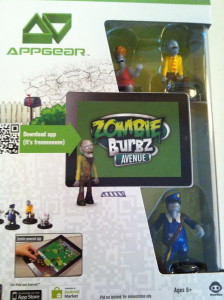
The big take away trend of TOY FAIR 2012, that officially begins tomorrow at the Javits Center in New York City, is the arrival of digital “enhancing” toys. There’s even a whole new vocabulary: you’ll hear that your child needs toys that help “blend” their reality and digital play experiences. Clever new brand lines such as Apptivity (Mattel) or AppGear (WowWee) or AppMates (Disney).
But at the end of the day, does your 18 month old baby really need a bear with an iPhone for a belly? Does your four year old who loves Hot Wheels really need to have a special car to race on the surface of your iPad? Does your child need a plastic fishing rod so that he or she can “virtually” fish with an attached smartphone?
I was pretty cranky this week as I started previewing this new category. I couldn’t quite put my finger on why and then yesterday, after having visited both Mattel and Hasbro’s showrooms, it became clearer to me. I wasn’t exactly cranky, just a little bit sad. I love toys. I’m always excited to see what those clever toy makers are going to wow us with. What innovative uses of technology would we be able to share with our readers? Unfortunately, this new category feels like the toy industry is desperately trying to remain relevant in a world where even the youngest children (who are not even talking yet), can navigate their parents smartphones and tablets.
The question for us always comes back to whether the technology enhances the play experience. In other words, do you need a toy to have the same or greater amount of pleasure when playing Fruit Ninjas or Angry Birds? Is the APP experience lacking or less than optimal if you don’t have these 3D action figures? Does having an iPhone APP at the center of your game board really make playing a round of LIFE or Monopoly better? As with most new categories we review, the ultimate answer will be made on a case by case basis.
In the swirl of wow-look-what-we-can-do-now in toyland, it’s almost easy to miss the next important question. Is this toy developmentally appropriate? We know that handing off iPhones and iPads to very young children has become part of our culture. Parents often marvel at how well their kids navigate such experiences, and we all know that such a hand off can be particularly useful when you travel or on a tedious line at the grocery store. (I can barely make it through the Whole Foods line without my phone.) But now ask yourself whether it’s beneficial to extend that time by adding toys to the experience. What other real world play experiences are being missed by adding more screen time? While the technology is far too new for studies that research the impact on small children, at this point we see no reason why this screen time will be vastly different from television, baby videos, or video games and their negative impact on children. In other words, less will probably be more. And when you’re talking about very young children, none may be even better. Not a popular suggestion we know. As with most things, we have a sense that moderation is probably the most realistic goal.
One more thing. It also seems somewhat tone deaf to be suggesting in these difficult financial times that expensive technology must be acquired for playtime. I know we all have phones and according to the folks at Mattel, one in every five house holds owns an iPad – but still. From a consumer point of view, board games have always offered great value. Most games cost under $20. Now, that’s $20 plus the cost of your iPad or iPhone.
I feel much better now. And while I understand that toy companies want in on this booming business, I hope that all of those creative toy makers will remember that playing in the real world with wonderfully crafted playthings is still something to be valued.
I’m in love with Flying Super Grover 2.0
The previews for Toy Fair 2012 ( that officially kicks off on February 12th) , which is a preview of the toys that will be available for the coming year, have begun. Are you with me?
So far, we haven’t been too blown away with what we’ve seen, but I have already found my toy crush…his name is Flying Super Grover 2.0.
We have only seen a prototype of Flying Super Grover (he’ll be available from Hasbro in the fall). So this isn’t an official review, but just look at him. The cap, the eyes peeking through, the splash of his yellow lightning bolt on his fury blue chest…and don’t even get me started on his pink nose. He promises to make appropriate sound effects when he’s flown. He will know when he’s going up and down. He had me at “helloooo every bud-deeeeee!” In any case, he clearly is going to give Elmo a run for his money.
Santa Claus in January
Like Santa Claus no one really wants to talk with us in January. Most parents have spent nearly 60% of their toy dollars during the holidays. Time to take a break. We do too. Both Joanne and I take the time to write and work on other topics. Joanne is working on a great civil war story and I’m having fun working on a new screenplay. It’s nice to change gears.
This week, the toy-related emails and phone calls have started again. All in in anticipation of Toy Fair that will take place in New York in mid-February. The UPS delivery guy has resumed delivering boxes to our office of toys that are ready for Spring. In other words, toy season will be here any minute.
I’m often asked about how you get into the toy business. Since we only review toys, I’m of very little help in this regard. I know it can be a daunting prospect. For example, if you have a great idea but little capital, how do you move forward? This morning I got a twitter message (more about that in a moment) about a new construction company called Qubits. We haven’t tested them yet. They are taking an interesting path by using kickstarter.com to get on their feet. Here’s their page if you’d like to read more about their product. We look forward to testing their sets with our testers.
Twitter. Finally took the plunge in a meaningful way this month. I’ve been enjoying the process of connecting with companies, moms, dads about play and toys – not to mention my non-professional interest in sporting events and award programs. Much like my first few weeks on facebook, I found twitter can be all consuming. There’s always some interesting link someone has pointed me to– articles that I might not otherwise have read. Then there’s the fun of connecting with people about the daily things (in case your counting, I’m approaching nearly a week without a Diet Coke). So if you’re on twitter, let me know. My twitter name is…toyportfolio.
Barbie: Cancer Survivor Version
A group of moms are petitioning for a cancer-surviving version of Barbie.
We think it’s a great idea for the following reasons:
1. Kids going through their own cancer treatments will love this concept especially if there are fun wigs and head wraps for Barbie to wear. Of course this would also hold true for kids with moms going through treatment. Playing with dolls is an ideal way for children to play out and talk about their fears and concerns. There’s something very comforting about Barbie going through the same experience. We love the idea of her being a role model for this journey that touches so many families.
2. Barbie has a huge adult collectors market. This doll would certainly find an audience with adults.
3.Fund raiser. Seems like an ideal way to support cancer research.
Do you agree?
Worst Toys of 2011
After reviewing 1,000s of toys this year, these particular products were rated the worst by our testers.
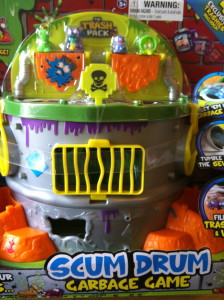
The Trash Pack. You collect tiny garbage cans. Honestly, that’s the game play. You collect garbage.
AppBlaster. You attach your IPhone to the plastic gun for a more hands-on virtual shooting experience.
True Heroes. “Nothing says Christmas more than automatic weapons and rocket launchers.” 
Fake marshmallows and sticks. Come on. Would it kill you to buy the real thing?
Fake fish sticks. Bad enough we have to eat the real thing. 
Justin Bieber Real Hairstyle Doll. We kind of miss the molded plastic shag.
Real Construction Safety Nail Gun. Comes with 100 nails.
Really?
For a list of amazing toys visit www.toyportfolio.com
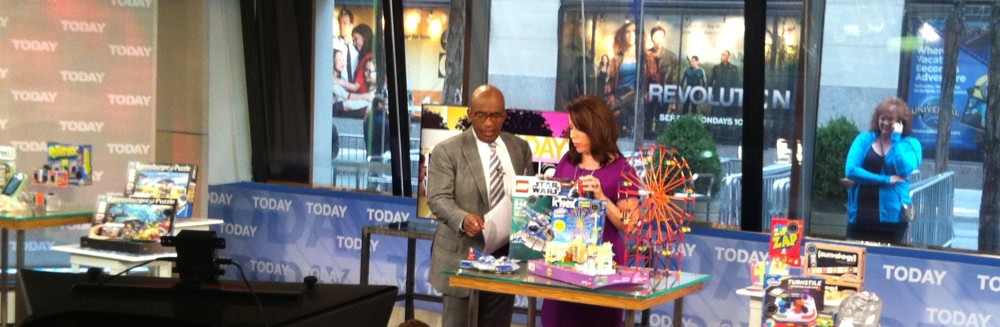
Classic Toys tomorrow on the Today Show: Take a Toy Inventory
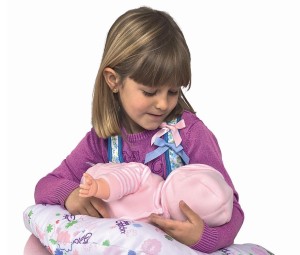
While there is certainly room for novelty this time of year, it’s also important to bring home toys that have lasting play value. The toys that make the cut tend to be the classics–and often more open-ended. These toys place your child at the center of the play experience. So instead of dolls that do all the talking, dolls that say nothing will be enjoyed for a longer period of time because they will say whatever your child wants them to say! (The doll to the left is from Corolle Doll’s Calin line). We’ll be talking balls, blocks, trains, art supplies and games!
Take a toy inventory:
1. Does your child have a variety of playthings? Having a lot of one type of toy (whether it’s dolls or trucks) will often lead to a chorus of “I have nothing to play with.”
2. Gender Free- Is your child’s play experience only pink? only blue? We want boys to know how to be nurturing parents–so dolls are an important part of role playing “dad”. On the flip side, we want our daughters to excel in math– so blocks and construction toys should be part of their play world as well.
3. Art supplies - Encourage their creative side. With budgets being cut in many schools, kids have fewer opportunities for painting, using clay, and drawing. Whether it’s a juicy box of new Crayola crayons or an interesting set of watercolor pencils from Faber Castell or eeBoo– find a way to bring them back to the arts.
4. Games- One of the best ways to unplug your family is to play a game together. We have dozens of great suggestions on our list. Find a couple that become part of your family’s entertainment. I’m personally really a fan of Connect Four Launchers and Joanne’s favorite is almost anything with letters. She’s a beast at Upwords. (Never quite referred to my mother that way–but you know what I mean).